America Is Having Less Sex Than at Any Point Since 1990. Sexy Stories Are Booming. These Two Things Are Not Unrelated.
Americans are having less sex right now than at any point since 1990, and that number has been declining, more or less continuously, for thirty-four years. And yet — in an apparent contradiction — the market for sexy stories is growing.
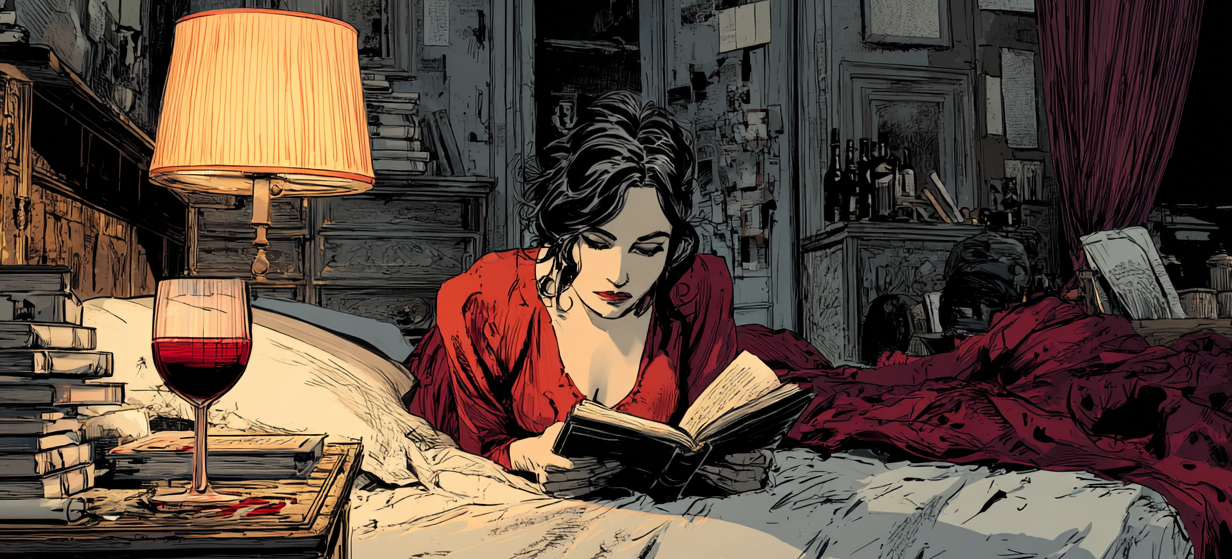
I just launched a platform for people who read sexy stories, which means I spend an unusual amount of time thinking about desire — who has it, what they do with it, what happens when the culture makes them feel bad about having it — and recently I read a statistic that caught me completely off guard, which is a little embarassing to admit when you consider that understanding desire is, technically, my job.
I was shocked, actually, because it directly contradicts what every television show and viral TikTok has been quietly telling me my whole life — which is that young people are out there having more sex than ever, that desire is everywhere, that the only problem anyone is having is having too much of it.1
This is what stopped me:
Americans are having less sex right now than at any point since 1990, and that number has been declining, more or less continuously, for thirty-four years.
By 2024 — not some dystopian future date we're still working our way toward, but last year — the share of adults having sex at least once a week had dropped from 55% to 37%, which is not a blip or an anomaly or a bad quarter, but a sustained, structural shift that the researchers who study it are describing as, and I am not making it up, a recession.2
The sex recession. That's the actual term.
And yet — in an apparent contradiction — the market for sexy stories is growing. Romance is the bestselling fiction genre in America. Indie platforms are expanding. Readers talk about these books the way people talk about therapy, pickleball tournaments or church. (You understand I say this with affection since I've built a platform for exactly this purpose.😏)
I don't think it's a coincidence that people are having less sex while reading more about it, and I don't think the explanation is as simple as "people are using books as a substitute for sex." It's more interesting and human than that, and it says something about desire that I think we don't have quite the right language for yet.3
How often do you read sexy stories?
Anonymous — your answers are never tied to your name or account.
The Recession, Up Close
The decline from 55% to 37% in weekly sexual activity isn't distributed evenly — it's hitting young adults particularly hard, which runs counter to basically everything the culture tells us about young people and sex ("young people these days"). Among adults aged 18–29, sexlessness has roughly doubled for young men over the last decade, and risen by around 50% for young women.5 This is the generation everyone assumes is having the most sex, and they are, statistically speaking, frequently actually not.
NPR spent months talking to young people about this, and the finding was one of those things that sounds obvious in retrospect but lands differently when you read it stated plainly: they weren't less interested in sex, they felt bad about themselves for not having more of it — what they were doing was outsourcing a lot of their sexuality to the internet, engaged with desire, exploring it, just not always finding their way to it with another actual human being in the room.6
The researchers have catalogued the reasons: fewer young people living with partners, more time on screens, a pandemic that interrupted years of developmental experience at exactly the age when people are supposed to be figuring out how to be physically close to each other, the exhaustion of dating apps, economic pressure.7
And then there's #MeToo — which needed to happen. But it landed into a culture that had almost no infrastructure for the conversations it required: no shared language for negotiating desire, no education around consent that went beyond "no means no," no cultural models for what an ethical, communicative sexual encounter actually looks like in practice. So a generation of people got a very clear picture of what could go wrong, with very little guidance on how to make it go right. That gap matters because it is still not being filled.
But here is the thing about desire: it doesn't disappear when the conditions for acting on it are hard. It goes somewhere. It finds a form.
Meanwhile, the Library Is Packed
Before launching Theo Reads, I ran a reader survey — talking to people who regularly read steamy or erotic stories, asking them about their habits, their preferences, what they were looking for, what they weren't finding — and one number has stayed with me ever since, which is that romance readers consume an average of 2.71 steamy stories a month, or about 32 a year, compared to the national average of 12.6 books a year across all genres.8 These readers are reading nearly three times more than the average American, and that's only counting this one category of book, the category they're apparently embarrassed to mention at dinner parties.
These are not casual readers dipping into something occasionally. These are people with a practice, something they return to consistently and with intention — and I think what that tells us, before we've even gotten to the content of the stories themselves, is that something is being provided here that people actually need, not just want.
The finding that stopped me, though, wasn't the reading frequency. It was this: 78% of readers said they read sexy stories primarily for entertainment, not as a lead-up to sex or orgasm.9
More than three quarters, reading for the experience of the story itself. For the emotional content of it, the feeling of it, the particular thing that happens when you spend time inside a narrative about desire and intimacy and being wanted — which, when you describe it that way, is not so different from why anyone reads anything, except that this version comes with the additional weight of cultural shame that most other genres don't.
Which brings me to who these people actually are, because the story we tell about them is almost entirely wrong.
The Bored Housewife Has Left the Building
The social judgement around steamy fiction readers is so pervasive and so specific that I think most people who read these books have just absorbed it as background noise: these are women with nothing better to do, substituting fiction for a real life, probably watching too much television as well.
Our data says otherwise, and fairly decisively.4 Only 5% of readers in our survey are homemakers. 78% are employed in some capacity. They are more educated than the average American — 56% hold a bachelor's degree or higher, compared to 47% nationally, and their household income tracks the national median. These are people with full lives, demanding jobs, probably more on their plates than they can comfortably manage, who have made a deliberate choice to carve out time for this kind of reading, which is not what escapism looks like — escapism is passive and accidental, and this is neither of those things.
And then there's the writer side of this, which surprised me even more: roughly a quarter of the people writing these stories are men.10
If you're still reading this post (I'm self-aware enough to know I'm rambling a little, ok?), this bears repeating. A quarter of the writers working in a genre that the culture has decided is exclusively about and for women are men — writing romance, writing erotica, writing across the full emotional and explicit range of what these stories can be — and nobody talks about it, because it doesn't fit the narrative.
The readership is similarly broader than the conversation around it suggests, and as Theo Reads grows I'll be sharing more of our platform data on this. What I can say now is that the "bored housewife" is not the reader in front of us, and may never have been.
What I Think Is Actually Happening
We are touch-starved — and I mean that in the largest possible sense, not just the sexual one. Less physically close to people than we used to be, less likely to have the kind of sustained, embodied connection that used to structure daily life almost without anyone thinking about it, before everyone got their own screen and their own curated corner of the internet to disappear into.
Desire doesn't disappear into that world with us. It keeps coming back, because it's not optional — it's not a preference or a hobby, it's a fundamental need for closeness and the feeling of mattering to another person. When that need doesn't have its ordinary outlets, it goes looking for others. For a lot of people right now, it goes into books, and I think this is not a failure or something to be ashamed of — I think this is exactly what storytelling has always been for.11
The 44% of readers in our survey who said they love these stories because they let them "fantasize about things I wouldn't do in real life" — that's not dysfunction, that's imagination working correctly, that is the entire long history of human beings using narrative to safely experience things beyond the boundaries of their own circumstances.12
The Part Where I Get Fired Up (more than usual)
When I started Theo Reads, I had a thesis I couldn't quite articulate — something about desire and shame and the gap between what people want and what they're allowed to want publicly, something about a genre that tens of millions of people love and almost nobody will admit to openly.
The sex recession data gave me a cleaner way into it. If people are having less sex and reading more stories about intimacy and being wanted, then what these books are doing is keeping desire alive in the gap — giving it somewhere to live while people are waiting for the rest of their circumstances to make space for it.
I built this platform because I think these stories deserve to exist without shame, without censorship, without the low-level embarrassment that follows them everywhere they go. I still think that. The data just helped me understand more precisely why.13
Theo Reads is open. No judgment. No wrong answers. Just good stories, and the particular relief of spending time inside a feeling that our lives just don't make room for anymore.
What do you read sexy stories for? Pick all that apply.
At Theo Reads you'll find the full spectrum — from slow-burn romance with enough tension to make you lose sleep to explicit, unflinching stories with content tags so detailed you'll never be surprised by something you didn't sign up for. Browse by mood, by trope, by heat level. Your reading habits are your own business.
Footnotes
1 The statistic arrived via a research paper I had not gone looking for, which had linked to a second paper, which cited the General Social Survey, which is where the evening took a turn. I regret nothing except perhaps the hour.
2 Institute for Family Studies, "The Sex Recession: The Share of Americans Having Regular Sex Keeps Dropping," 2025. The General Social Survey has been running continuously since 1972. ifstudies.org
3 To be clear: "sexy stories are a substitute for sex" is not my thesis. My thesis is that desire needs somewhere to live, stories are one of the places it lives, and we have somehow collectively decided to be embarrassed about the version of it that involves explicit content, which seems like a mistake.
4 Reader data throughout this post comes from a proprietary customer needs survey conducted by Theo Reads in July 2023, with 147 qualifying respondents (adults 18+ who regularly or occasionally read erotica or steamy romantic stories). Directional rather than definitive, but consistent with broader industry patterns.
5 Institute for Family Studies, "Sexless America: Young Adults Are Having Less Sex," 2024. ifstudies.org
6 NPR / WHRO, "Gen Z Is Afraid of Sex — and for Good Reason," July 11, 2025. whro.org
7 The causal picture is genuinely complex and still being studied. The digital displacement thesis is particularly well-documented; COVID's role in disrupting developmental milestones for young adults is more recent but widely considered a contributing factor.
8 The 12.6 books per year figure is drawn from Pew Research Center data and publishing industry surveys. The 2.71 steamy stories per month figure comes from our July 2023 reader survey.
9 Proprietary reader survey, Theo Reads, July 2023. 77.55% of respondents chose "I just enjoy reading them in my free time, not as a lead up to sex or orgasm" as their primary reason for reading.
10 Proprietary writer survey, Theo Reads, September 2023. Of 100 respondents who identified as writers of erotica or romantic stories, 25.93% identified as male. Small sample; read as indicative rather than definitive.
11 "What storytelling is for" is a large claim that philosophers and literary critics have been arguing about for centuries. I am using it loosely. The point stands.
12 Proprietary reader survey, Theo Reads, July 2023. 43.66% of readers cited "I can fantasize about things I wouldn't do in real life" as something they like about these stories.
13 The embarrassment, to be clear, is not the readers' problem to solve. It is a cultural problem, and one we are actively working on, one post at a time.