You're Not Escaping Your Feelings. You're Finally Having Them.

The emotion you're actually chasing when you pick up a romance novel — or an erotica story? It's not happiness.
I run a platform for people who read sexy stories, so I spend a lot of time observing why people read them...and it's not what you'd think.
If you ask a romance reader why she reads romance, she will say "I just needed something light." She is currently on page 347 of a book that has made her cry four times, ugly-crying through many of them. Light reading? Hmmm.
The truth is that romance readers are chasing very specific emotional states, with the precision of a sommelier selecting a wine pairing, and these are not the easy emotions either. I know this because I am in the throes of building emotion taxonomy for Theo Reads — a set of reactions readers can use to tag what a story did to them — and what came back was not a list of pleasant feelings. It was longing, desperate, devastated, overwhelmed, heartbroken, gutted.¹ People are selecting, deliberately and repeatedly, the emotions that hurt.
And this raises an obvious question.
Why Would Anyone Choose to Feel Wrecked?
Because it's safe.
Our nervous system doesn't entirely distinguish between fictional loss and real loss - the grief response, the racing heart, the involuntary tears - but the part of our brain that tracks consequences knows perfectly well that nothing bad actually happened. So we get the full emotional experience without any of the damage. Aristotle called this catharsis 2,400 years ago and the mechanism hasn't changed.²
Romance adds something tragedy doesn't: the guaranteed resolution. The HEA — happily ever after — is both a genre convention and a psychological contract. We agree to be devastated because the genre promises that it will resolve. Real life doesn't make that promise.
Think of it as emotional weight training. We are lifting feelings heavier than anything in our daily life, in a gym where nobody actually gets hurt. Genius, right?
And Erotica?
Ok, so here's where I'm gonna push back on the cultural assumption that erotica is about the body and romance is about the heart. That's just a false dichotomy.
Look, desire is an emotion. Surrender is an emotion. The slow build of anticipation, the tension of want, the particular release of finally — these are all erotic mechnisms but they're also emotional states that are as real and as complex as grief or longing. Erotica readers are doing exactly the same thing romance readers are doing: chasing a specific feeling, safely, in a container where they control the experience.
The difference, of course, is which emotions they're chasing. Romance readers chase longing and devastation and relief. Erotica readers chase desire and surrender and release. Going back to the earlier analagy: both are emotional weight training. The gym is the same, but the muscle group is different.
The cultural embarrassment attached to erotica is the same embarrassment attached to wanting things too openly and honestly today. We have been taught, very thoroughly, to be embarrassed about feeling. (I'm just gonna be honest here again - I mean, why stop now - reading smut embarrasses me not even a little)
Carl Jung Knew Something About This
As a psychologist, Jung gave us archetypes and the collective unconscious, and a concept called the Shadow. In plain English: every person has a Shadow, the parts of themselves they've buried because someone told them those parts were wrong. Too needy. Too angry. Too sexual. Too dark. This Shadow doesn't magically disappear over time. It just goes underground and waits.
Fiction, especially fiction that goes to uncomfortable places, gives the Shadow somewhere to go. We read it, we feel it, and something in us quietly exhales. That's actually healthy and good. We meet our Shadow and get to know it better. We heal the parts of it that we need to and integrate the rest.
Jung also had a concept he called Active Imagination: using fantasy deliberately to access the parts of ourself that we can't reach in ordinary life. He considered it a legitimate therapeutic tool. Every time we read about a character's desire, grief, or surrender, that's Active Imagination. We're not escaping our inner life, we're simply entering it through a different door.
And then there's something he called Individuation — the lifelong process of becoming fully ourselves, which requires integrating all the parts, including the ones we've hidden. Every time a reader recognises herself in a story she thought was shameful, something small and real shifts. That's Individuation. It happens quietly, on our phone, on a Wednesday night like tonight.³
This Next Part Makes Me Very Angry and Very Sad
We live in a culture that has systematically pathologized emotion.
I worked for many years in Corporate America (some of my social media profiles still say I "worked for the man, now I'm my own bitch"). We are told to suppress feeling under the guise of "professionalism." People apologize for saying "I feel like—" in meetings, as though having feelings is an embarrassing cognitive error rather than evidence of being a person.⁴ Men are told crying is weakness. Women are told we're "too emotional" the moment we express anything inconvenient.
And then there is romance, and erotica, both of which are structurally about feeling things. Every trope exists to produce a specific emotion. Every slow burn is engineered to make us ache. Every HEA is designed to make us believe, for the duration of the story at least, that love is real and we deserve it. Every erotica story gives our desire permission to exist, fully, without apology.
This is not escapism from emotion. It is, in fact, the only place in many people's lives where emotion is the entire point.
Calling it a guilty pleasure is just one more way of saying: you shouldn't feel.
Look, we are meant to feel the full range of emotion — the longing, the desire, the devastation, the surrender, the relief. It's how we heal ourselves from past traumas. And it's what allows us to love. And that, my wonderful readers, is what these stories are actually for.
So I say instead: Feel this much. Feel much more.
A Quick Word on Reviews (Because I Have Feelings)
I launched the reviews system at Saks Fifth Avenue many years ago, so I know a thing or two about how they work, and more importantly, how they don't.
Here is the uncomfortable truth about reviews: roughly one in every 500 readers actually leaves one.⁵ The rest finish the book, close the app, and move on with their lives. So the reviews that do exist are wildly unrepresentative. They skew toward the people who were angry enough to write something, or close enough to the author to do her a favor.
The reality is that reviews are not a reader tool. They're really an algorithm tool, designed to help platforms decide what to surface next.
So today, we did something about it.
When you finish a story on Theo Reads, we ask you two things. Would you recommend this to another reader? And how did it make you feel?
That's it.
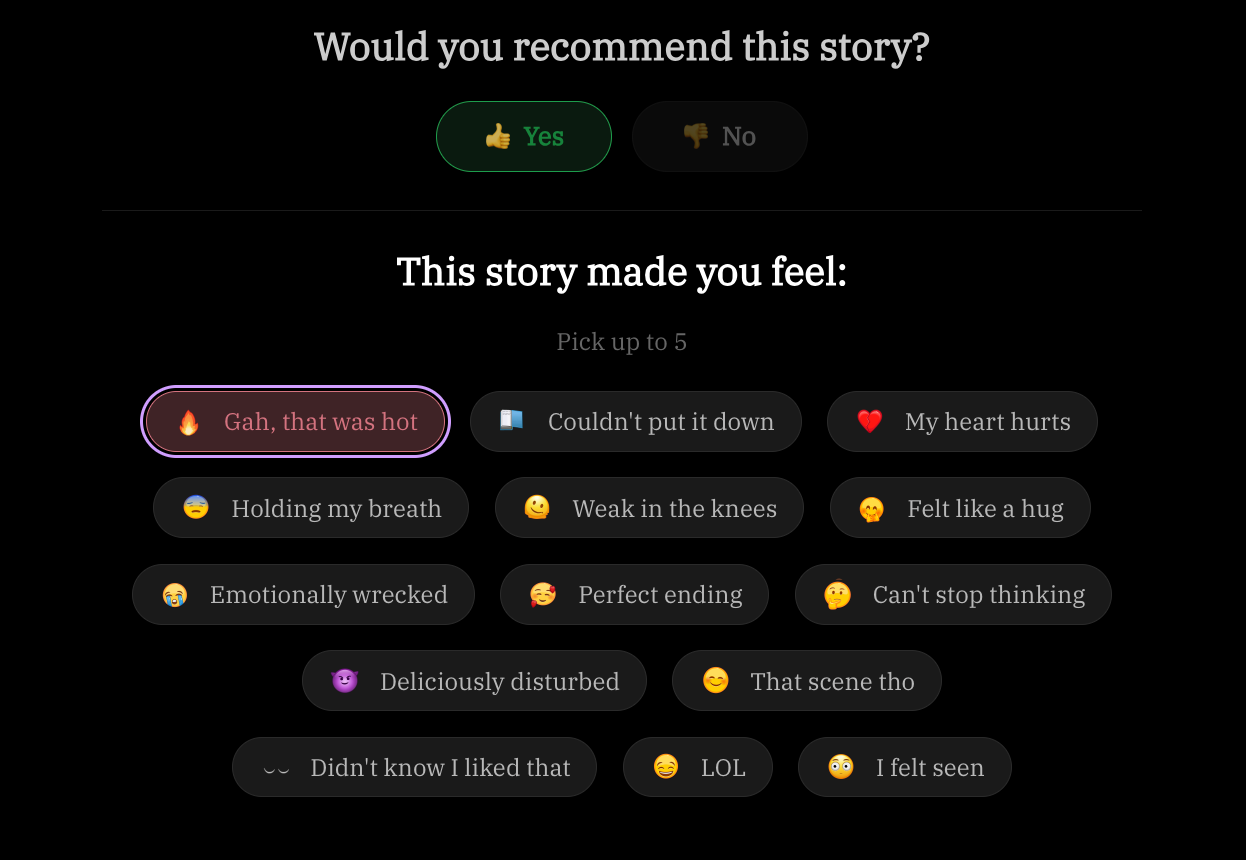
But this feature is only the start of something much, much bigger. We're building an emotional map of every story and every emotion that a reader feels on the platform. Eventually, you'll be able to find your next read by emotion alone. That's where this goes.
Take that, guys at the Zon.
Theo Reads is a platform for people who believe feeling things is not a guilty pleasure. When you finish a story, tell us how it made you feel. That data becomes the map.
Footnotes
¹ The full Theo Reads emotion taxonomy: tender, comforted, joyful, longing, desperate, desire, heartbroken, devastated, gutted, frustrated, furious, shocked, relieved, hopeful, overwhelmed. More than half are painful. That is the point.
² Aristotle's concept of catharsis appears in the Poetics, circa 335 BCE. The basic mechanism — feeling safely produces relief — has substantial empirical support in modern psychology.
³ Jung's Shadow, Active Imagination, and Individuation are drawn from his collected works, particularly The Archetypes and the Collective Unconscious (1959) and Memories, Dreams, Reflections (1962). He was writing about dreams and therapy. He would have had thoughts about romance fiction. I think he would have approved.
⁴ There are now LinkedIn posts, management books, and corporate training programs dedicated to removing "I feel like" from workplace communication. The argument is that feelings are subjective and therefore invalid as professional input. This is worth sitting with for a moment.
⁵ Industry estimates put review conversion at roughly 1 per 500 reads. Some put it closer to 1 in 1,000.